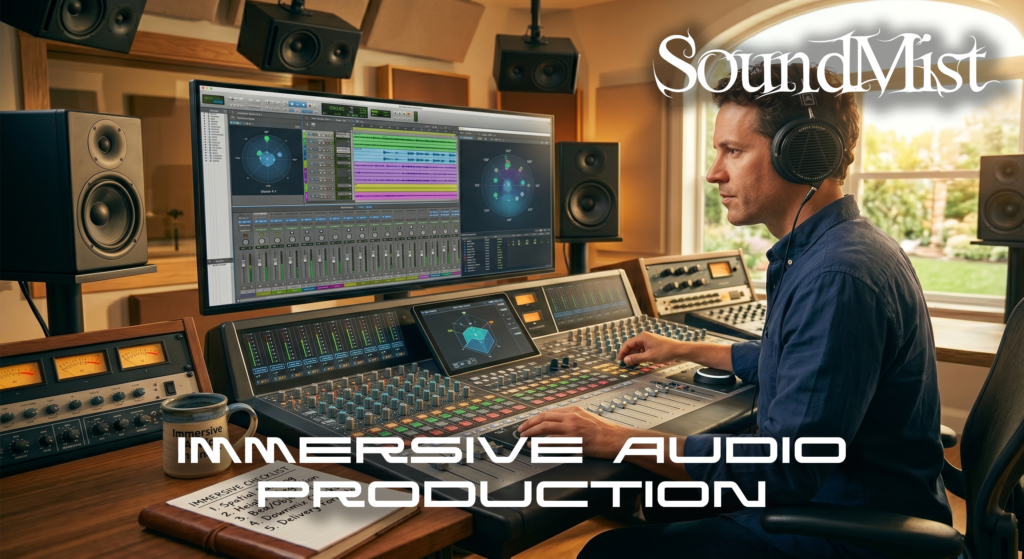
Immersive audio production is transforming how listeners experience sound. Formats like Dolby Atmos allow producers to place audio in a three-dimensional environment.
Unlike stereo, immersive audio is not limited to left and right channels. Sounds can be positioned above, behind, and around the listener.
This format is widely used in film, gaming, and now increasingly in music streaming platforms.
Producing immersive audio requires a compatible DAW, specialized plugins, and often a multi speaker setup or binaural rendering for headphones.
One key concept is object-based mixing, where sounds are treated as individual objects rather than mixed channels.
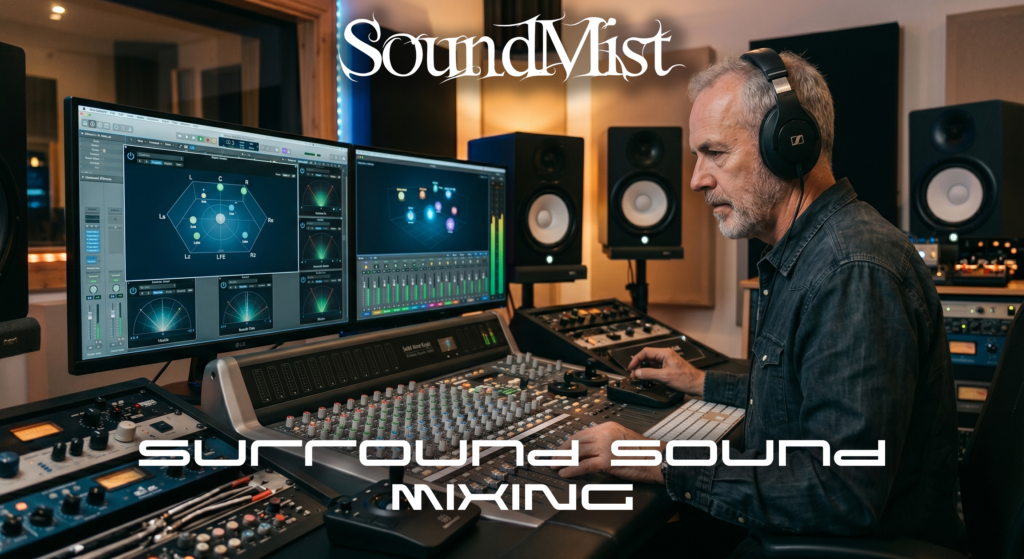
Surround sound mixing goes beyond traditional stereo by placing audio in a three dimensional space. It is widely used in film, gaming, and immersive audio experiences.
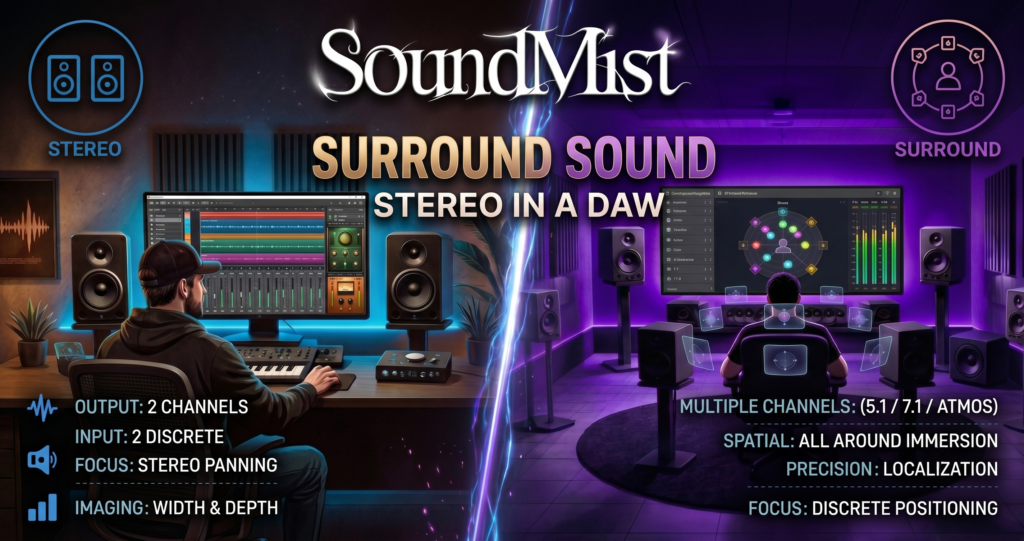
Unlike stereo’s two channels, surround sound systems use multiple channels such as 5.1 or 7.1. These include front, center, rear, and subwoofer channels, allowing sound to move around the listener.
In a DAW, surround mixing requires routing audio to multiple outputs. Instead of simple panning, you position sounds in a 360-degree field.
Dialogue is typically placed in the center channel, while ambient sounds and effects are spread across rear speakers to create immersion.
To work effectively, you need a compatible DAW like Pro Tools or Logic Pro, a multi-output audio interface, and a calibrated speaker system.
One of the biggest challenges is ensuring your mix translates well to stereo, as many users still listen on headphones.
Surround Sound vs Stereo in a DAW: Complete Guide for Music Producers (2026)
Description: Learn the difference between surround sound and stereo in a DAW. Discover which format is best for music production, mixing, and immersive audio work flows.
Surround Sound vs Stereo in a DAW: What You Need to Know
Choosing between surround sound and stereo in a DAW (Digital Audio Workstation) can directly impact how your music or audio project is experienced. While stereo remains the industry standard for most music production, surround sound is rapidly gaining traction in film, gaming, and immersive audio. This guide breaks down the differences, work flows, and practical use cases so you can decide which format fits your production needs.
What Is Stereo Audio in a DAW?
Stereo audio uses two channels: left and right. It is the most widely used format in music production because it works seamlessly across all playback systems.
Surround sound uses multiple channels (such as 5.1 or 7.1) to create a more immersive listening experience. It allows audio to move around the listener, including front, back, and sometimes height (Dolby Atmos).
Dolby Atmos is transforming audio production by enabling true 3D sound placement. Streaming platforms are increasingly supporting spatial audio, making surround formats more relevant than ever. Stay ahead of trends: https://soundmist.com/audio-production-trends.
Final Thoughts
Stereo remains essential for everyday music production, but surround sound is shaping the future of immersive audio. Understanding both formats gives you a competitive edge as a producer. For a complete learning path, visit: https://soundmist.com/audio-production-guide