audio production

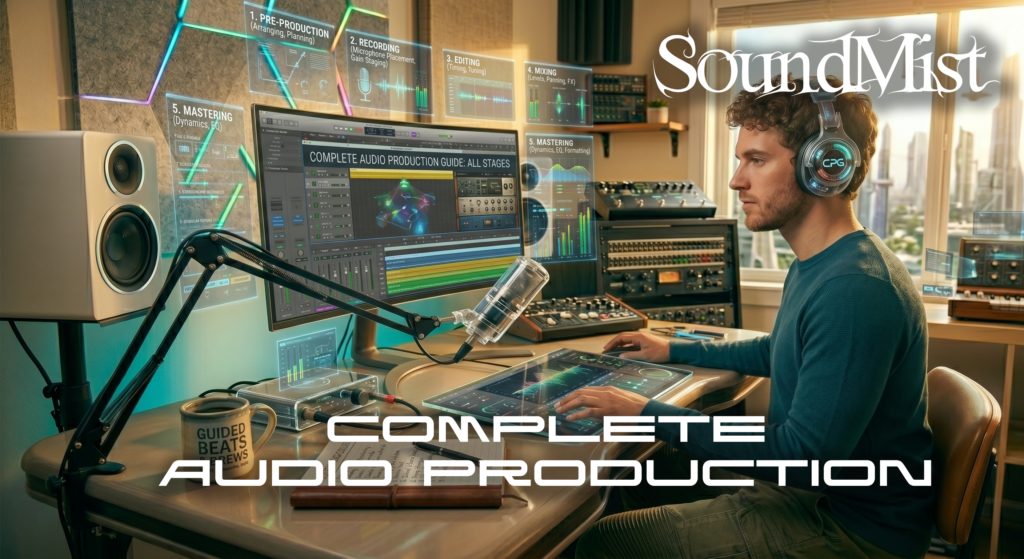
Complete Audio Production Guide

SoundMist Complete Audio Production

Complete Audio Production Guide

Audio production involves multiple stages, from recording to mixing and mastering.


The process begins with recording clean audio using proper mic placement and gain levels.


Next comes editing, where you remove noise, correct timing, and prepare tracks for mixing.


Mixing involves balancing levels, applying e ects, and creating a cohesive sound.


Mastering is the final step, ensuring your track sounds polished and consistent across all playback systems.


Most beginners start with stereo production, but advanced creators may explore surround and immersive formats.


Learn the key dfferences here: https://soundmist.com/surround-sound-vs-stereo-in-a-daw/

Understanding the full work ow helps you produce professional-quality audio from start to finish.

Complete Audio Production Guide Read More »

Audio Production Trends

SoundMist Future Audio Production

Future Of Audio Production

Audio production is evolving rapidly, driven by new technology and changing listener expectations.


One of the biggest trends is spatial audio, including Dolby Atmos. Streaming platforms are increasingly supporting immersive formats.


AI-powered tools are also becoming more common, assisting with mixing, mastering, and sound design.


Remote collaboration has grown, allowing producers to work from anywhere.


Despite these innovations, stereo remains dominant for music distribution.


To understand where things are heading, compare current formats: https://soundmist.com/surround-sound-vs-stereo-in-a-daw/

Staying updated with trends helps producers remain competitive in a fast-changing industry.

Audio Production Trends Read More »

Immersive Audio Production

SoundMist Immersive Audio Production

Immersive Audio Production Guide

Immersive audio production is transforming how listeners experience sound. Formats like Dolby Atmos allow producers to place audio in a three-dimensional environment.


Unlike stereo, immersive audio is not limited to left and right channels. Sounds can be positioned above, behind, and around the listener.


This format is widely used in film, gaming, and now increasingly in music streaming platforms.


Producing immersive audio requires a compatible DAW, specialized plugins, and often a multi speaker setup or binaural rendering for headphones.


One key concept is object-based mixing, where sounds are treated as individual objects rather than mixed channels.


If you are transitioning from traditional workflows, start here: https://soundmist.com/surround vs stereo in a daw

Immersive audio opens new creative possibilities, but it also requires a deeper understanding of spatial design.

Immersive Audio Production Read More »

Surround Sound vs Stereo in a DAW

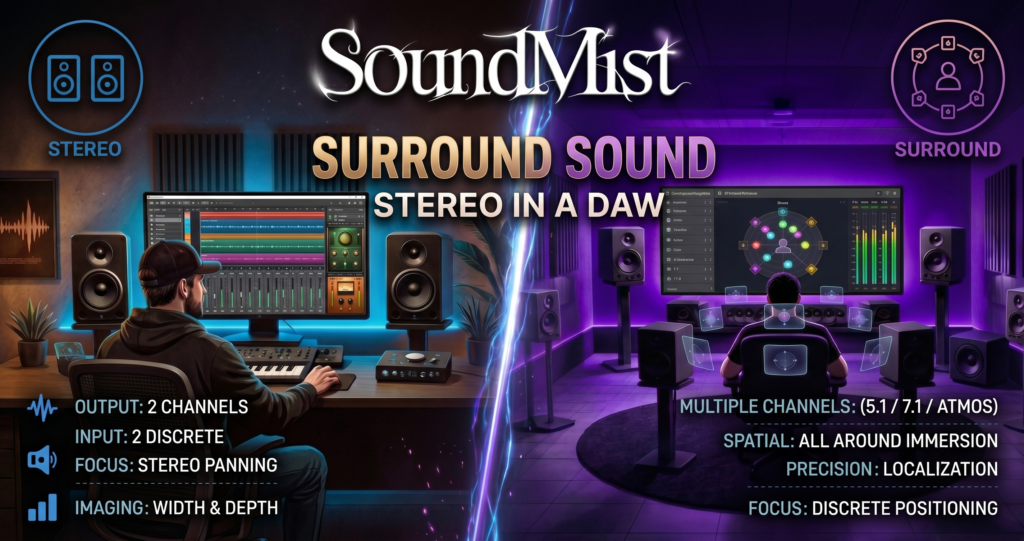
SoundMist Surround Sound vs Stereo

Surround Sound vs Stereo in a DAW: Complete Guide for Music Producers (2026)

Description:
Learn the difference between surround sound and stereo in a DAW. Discover which format is best for music production, mixing, and immersive audio work flows.

Surround Sound vs Stereo in a DAW: What You Need to Know

Choosing between surround sound and stereo in a DAW (Digital Audio Workstation) can directly impact how your music or audio project is experienced. While stereo remains the
industry standard for most music production, surround sound is rapidly gaining traction in film, gaming, and immersive audio. This guide breaks down the differences, work flows, and practical use cases so you can decide which format fits your production needs.

What Is Stereo Audio in a DAW?

Stereo audio uses two channels: left and right. It is the most widely used format in music production because it works seamlessly across all playback systems.

Inside a DAW, stereo mixing focuses on:

  • Panning instruments across the left-right field
  • Creating depth using reverb and delay
  • Balancing frequencies with EQ and compression
  • If you’re new to mixing, start with this guide: https://soundmist.com/stereo-mixing-basics

What Is Surround Sound in a DAW?

Surround sound uses multiple channels (such as 5.1 or 7.1) to create a more immersive listening experience. It allows audio to move around the listener, including front, back, and sometimes height (Dolby Atmos).

Inside a DAW, surround mixing involves:

Key Differences Between Stereo and Surround

Key Differences Between Stereo and Surround Sound

  • Channels: Stereo uses 2 channels; surround uses 6 or more
  • Spatial Design: Stereo is left-right; surround is 360-degree
  • Work flow Complexity: Stereo is simple; surround requires advanced routing
  • System Requirements: Stereo works on headphones; surround needs multi-speaker setups

  • For performance optimization tips, visit: https://soundmist.com/daw-performance-tips

When to Use Stereo in Music Production

Stereo is best for:

When to Use Surround Sound

Surround sound is ideal for:

DAW Setup for Stereo vs Surround

Stereo setup:

  • Audio interface (2 outputs)
  • Headphones or studio monitors

Surround setup:

Cost Comparison

Stereo is budget-friendly and accessible for beginners.

Surround sound requires:

The Future: Dolby Atmos and Spatial Audio

Dolby Atmos is transforming audio production by enabling true 3D sound placement. Streaming platforms are increasingly supporting spatial audio, making surround formats
more relevant than ever.
Stay ahead of trends: https://soundmist.com/audio-production-trends.

Final Thoughts

Stereo remains essential for everyday music production, but surround sound is shaping the future of immersive audio. Understanding both formats gives you a competitive edge as a
producer.
For a complete learning path, visit: https://soundmist.com/audio-production-guide

Surround Sound vs Stereo in a DAW Read More »